Wednesday, March 28, 2018

Feedback is More than an Add-on


In modern PD, we spend a lot of time discussing the why of adopting new practices. But, in this post, I'd like to focus on the how.  Specifically, how to create more opportunities to connect and provide effective feedback. I’d like to focus this post on the #1 tool I use in class for feedback, Pear Deck.
Pear Deck is a great tool for students to interact with a presentation. It allows for collecting student thinking to drive instruction and creating opportunities for student reflection during instruction. Students can interact via any web enabled device from a laptop to a smartphone. It is a gigantic leap over clickers and tools like poll anywhere because of the interactions it allows learners to have and the forms of feedback that can be collected.
With the recent addition of the Pear Deck add-on for Google Slides, I think it’s a great time to share more information about, how it can be used. Pear Deck is a Freemium piece of software. While teachers can pay for a subscription and get a large number of additional features, I’d like to focus only on the free features that are available with the Pear Deck add-on.

Getting add-on

The first thing to do is open Google Slides and go to Add-ons in the top toolbar.
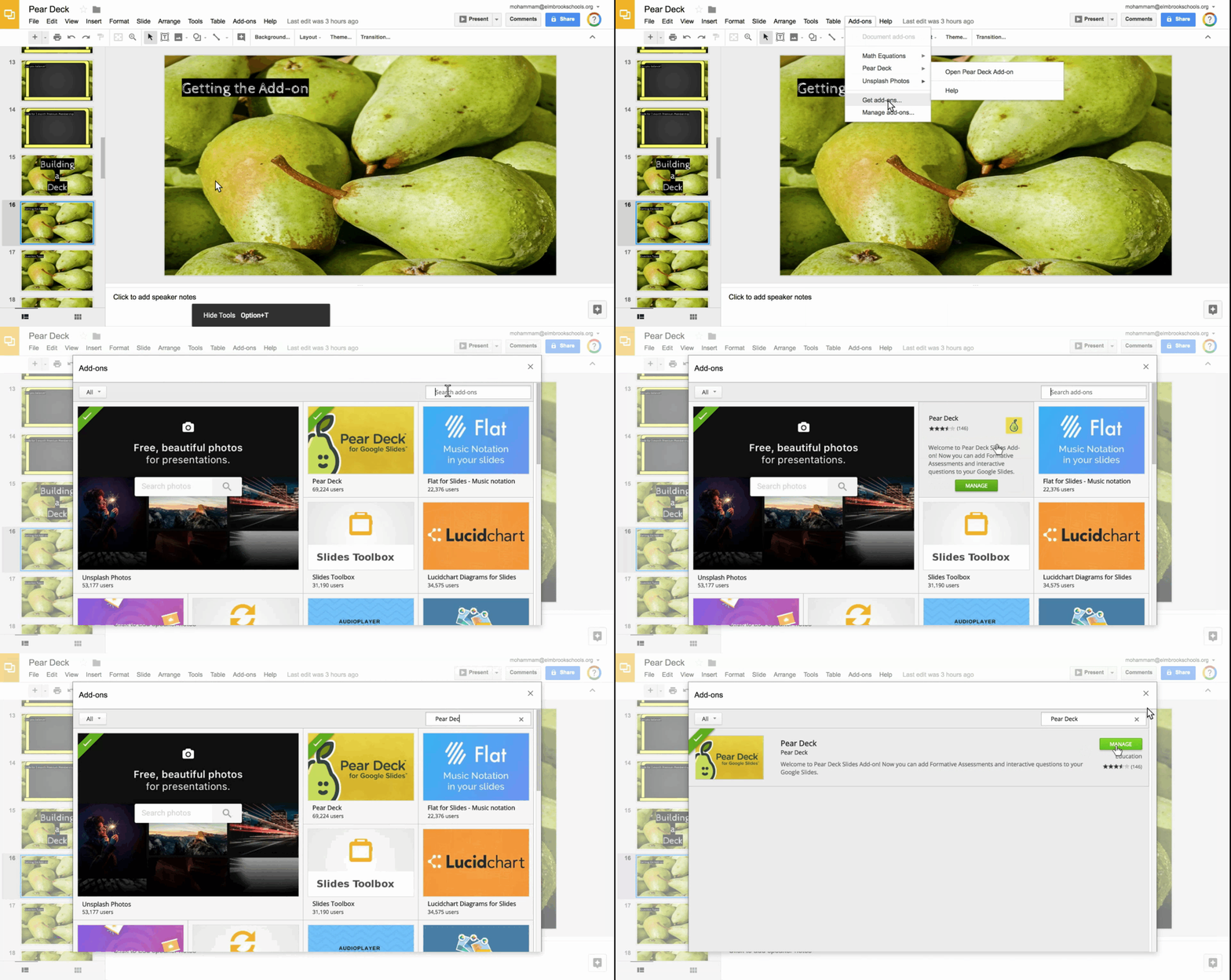

Opening the Sidebar

Once you’ve added the add-on, you can access it’s features by opening the add-on.
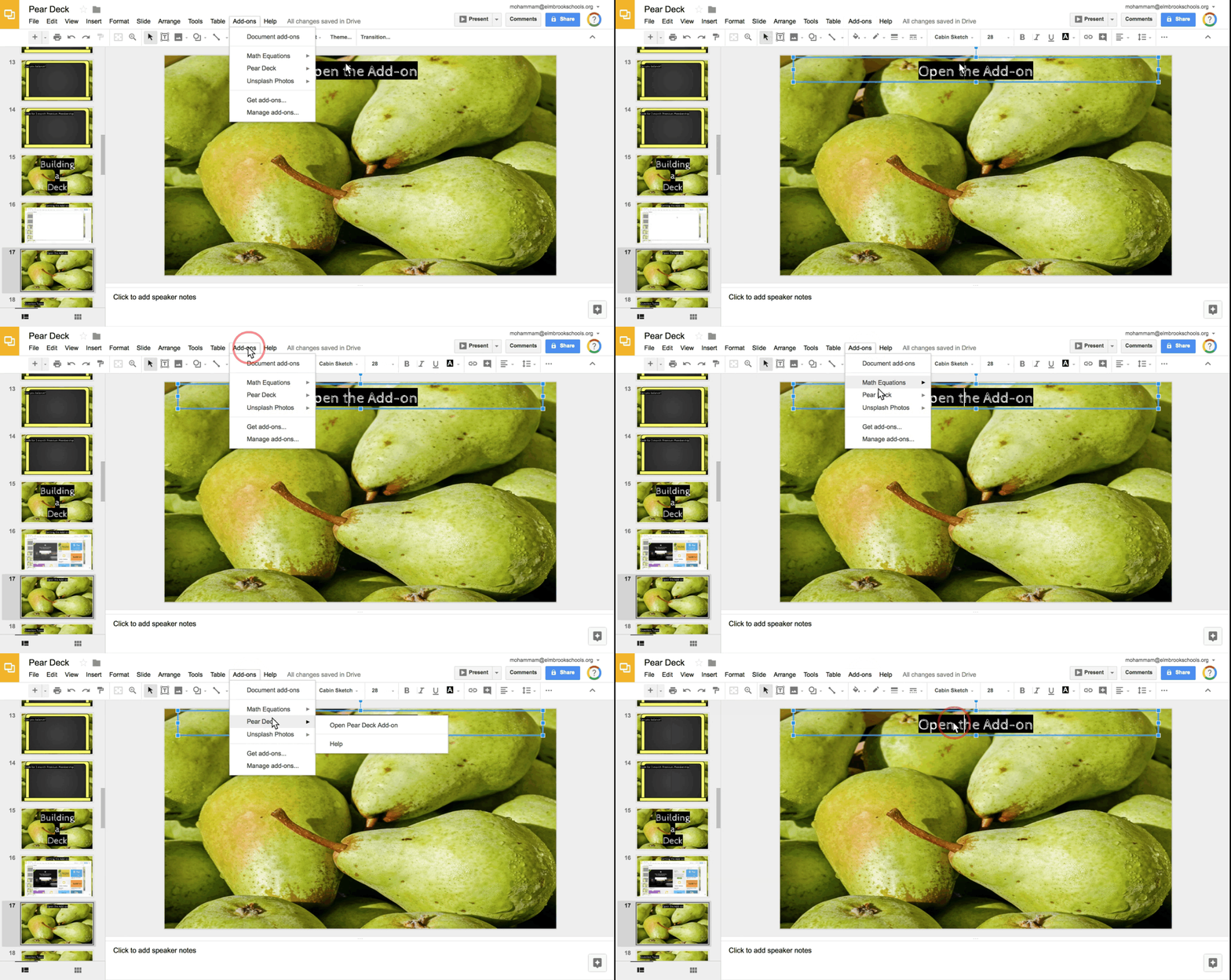
The sidebar is where all the functionality is for the add-on. From the sidebar you can
  1. Add student response slide templates from the gallery
  2. Turn the current slide into an interactive slide 
  3. Present a Pear Deck to your class


Slide Templates

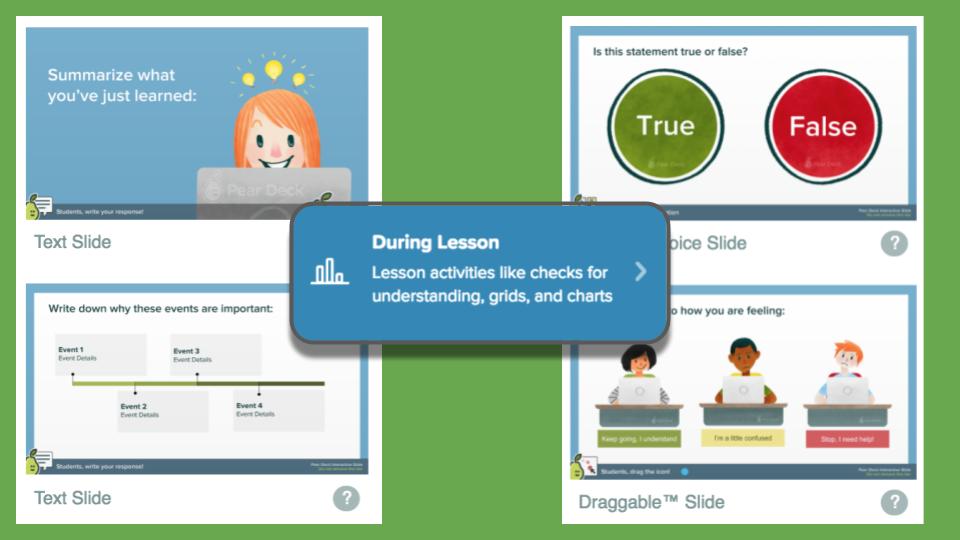
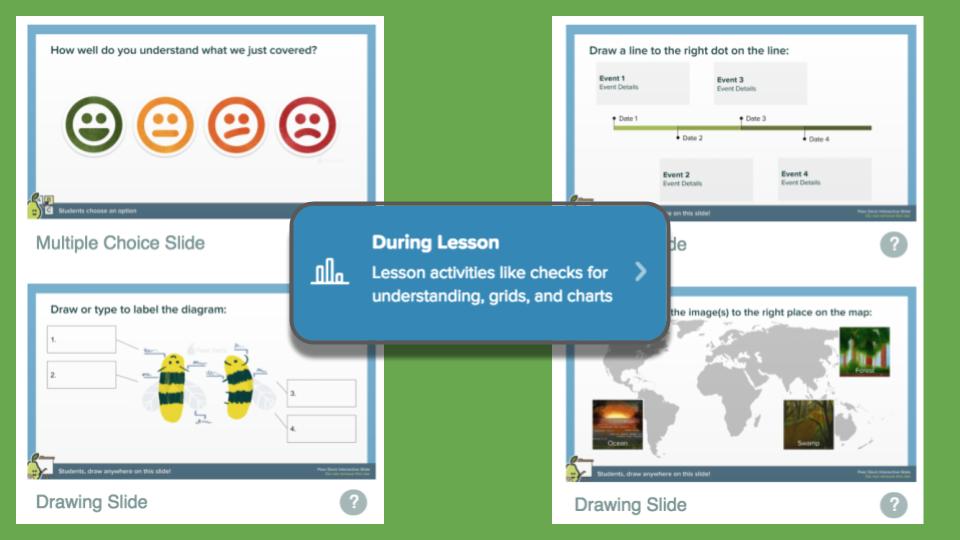
The add on provides a gallery of different pre-made interaction slides that are completely editable.  

They are divided into 3 different categories

  • Beginning of Lesson - Think of these as a way to tap into prior knowledge or build curiosity related to a topic before you begin digging deeper.


  • During Lesson - These are great ways to check for understanding or provide opportunities for discussion where every student’s ideas can be heard during instruction.

  • End of Lesson - Think of these as opportunities for students to reflect and summarize learning from the lesson and a way for teachers to get some feedback about the lesson.
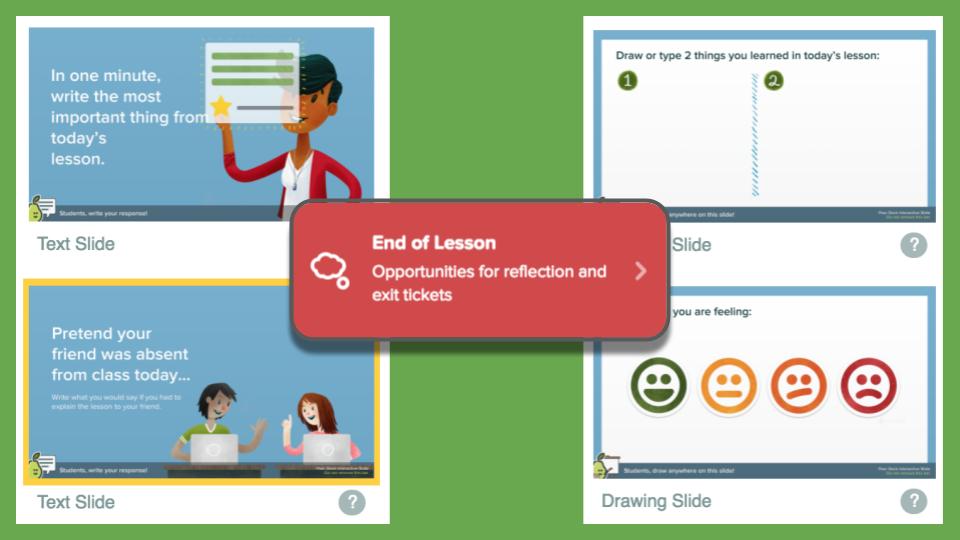
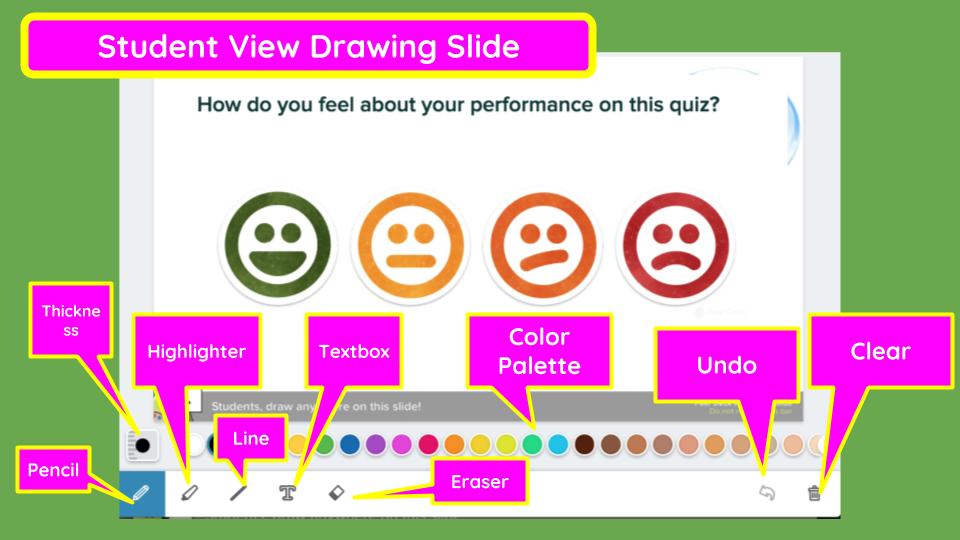
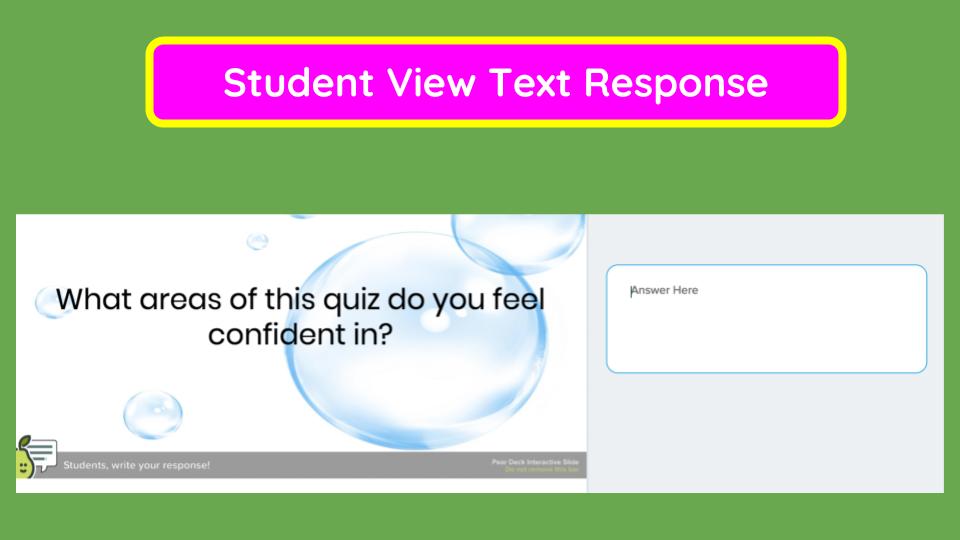
The templates provide for a wide variety of learner response modes beyond multiple choice.  They include drawings, dragging a dot, text and numerical response.
So if you open a presentation you already have, you can just add these slides wherever you’d like to get students to interact with the presentation and their peers.


Adding Response to a Current Slide

You don’t need to use the templates from Pear Deck to create interactions.  You can create or use your own slides then add an interaction via the sidebar.  You can make any slide a text response, numerical response, or a multiple choice. With the slide open, just click the option you would like from the sidebar and follow the pop-up instructions.
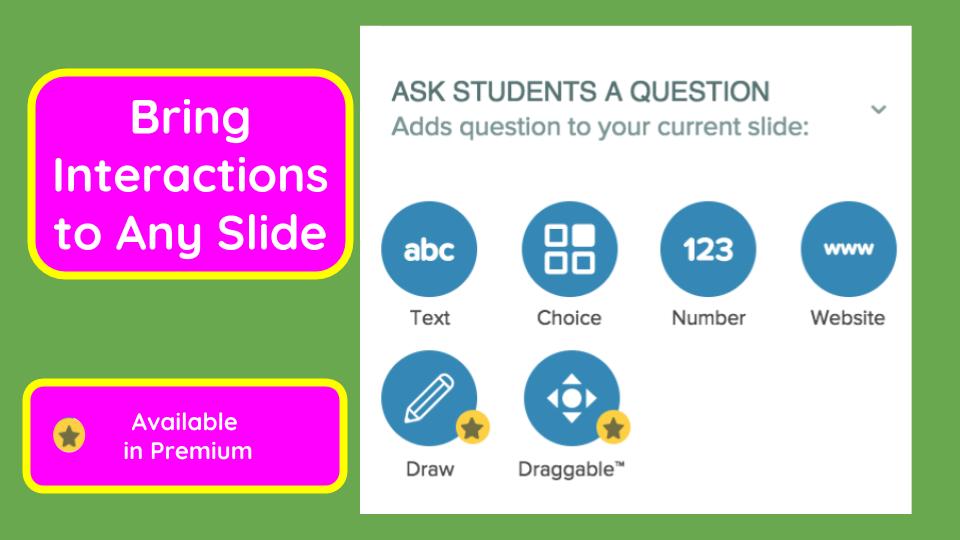
You can also add a web link that will direct student devices to that link while you project what is on your current slide. Perhaps, instructions may be displayed on the slide while students would be taken to an article to read or simulation to experiment with on the web.
The two question types not available to add-on to a slide you created are draw and Draggable (these are premium features). But remember, there is a gallery of these that can be used and altered with no requirement for a premium account.


Start Presenting

When you’ve got your presentation all ready, you can again use the sidebar to launch your presentation.
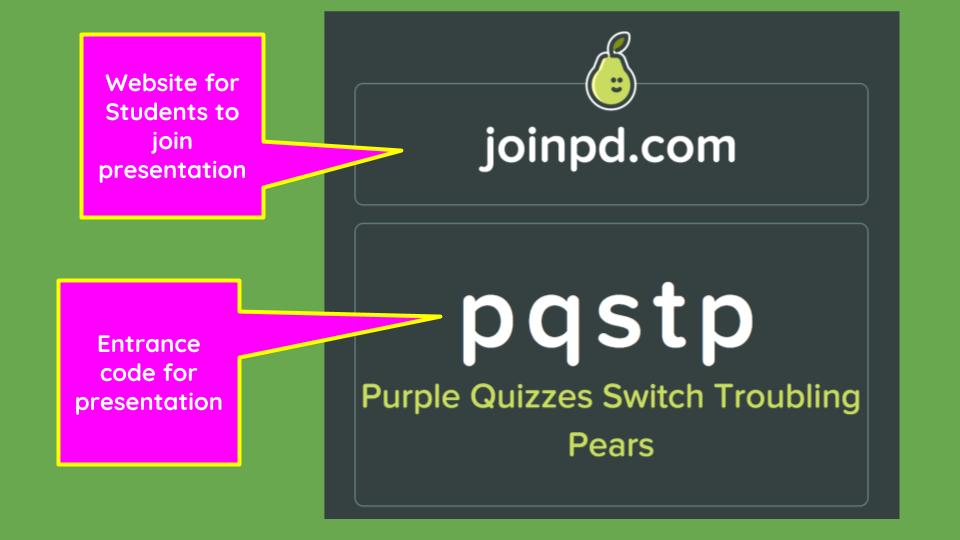
A code will appear on the projector that will direct students to join the presentation session.

Presentation Controls

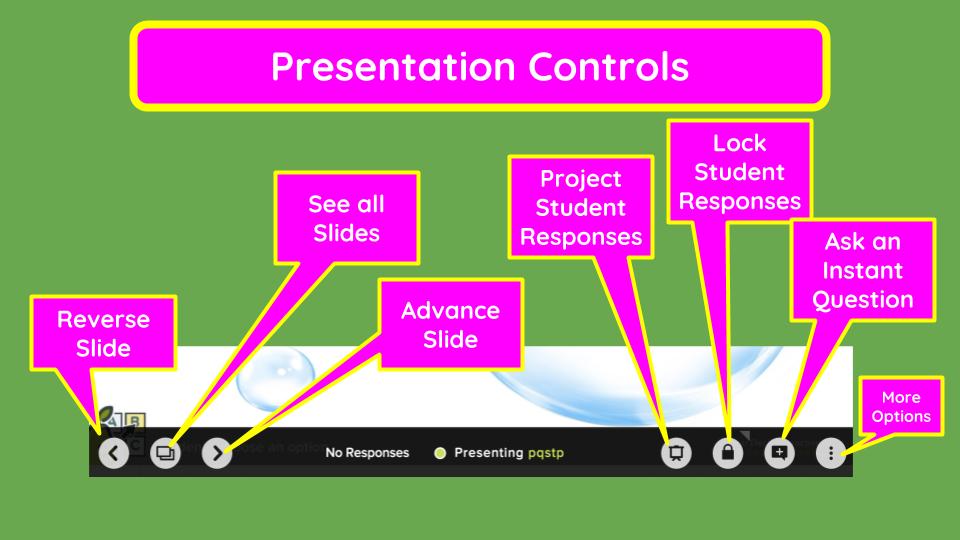
Once students have logged in, use the control bar at the bottom of the screen to navigate through your presentation.
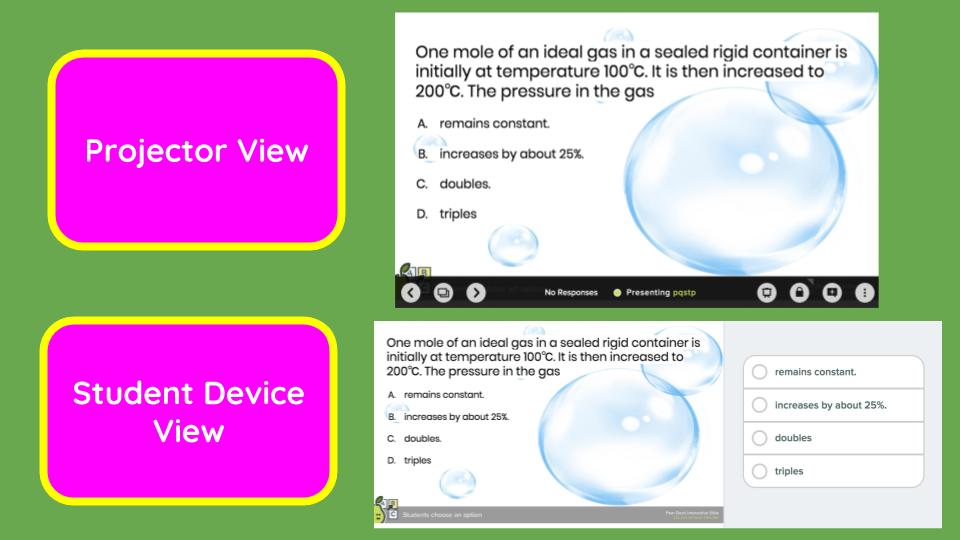
As you progress through slides, students will see the projected version on their device. When you reach a response slide, students will have space to respond aligned to the type of interaction.
Looking at Data in Real Time

So students are responding to a question, what next? By hitting the lock button, you can lock students from responding. The project button, shows student responses on the projector. No student names are ever projected.  Responses can be toggled to see an overlay of the class as a whole or each response individually. This is a great way to see where you are as a class in order to guide next steps for instruction in real time.
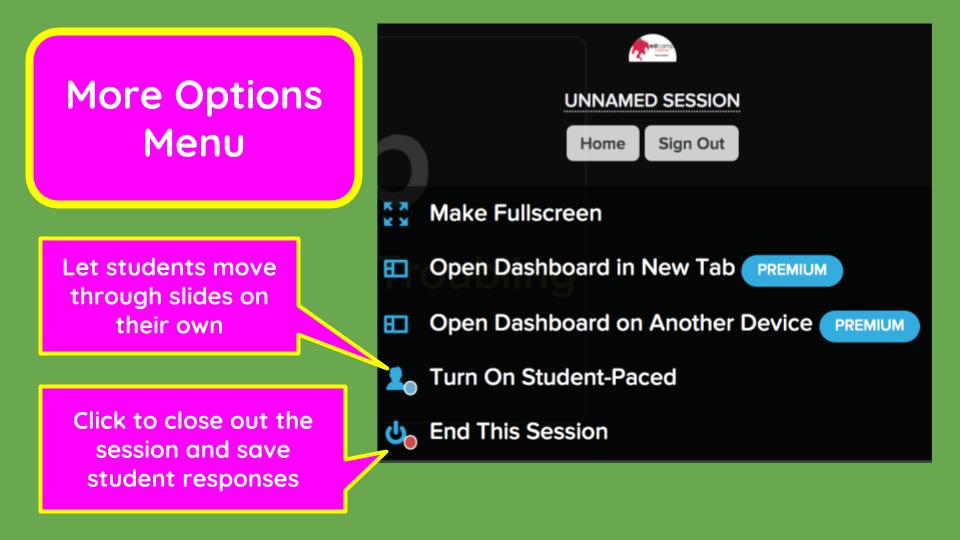
In addition, you can add questions on the fly with an instant question option. And the more option menu (the three dots in the bottom right hand corner) gives you the ability to let students work through a presentation at their own pace.  I use this option for all of my practice quizzes. I give students a set amount of time to work through the slides and then we discuss/correct them together.

Looking at Data After the Fact

When your done with a presentation, hit the end session button under the more options menu.
To revisit the session and get more information, head to PearDeck.com and login. Here, you will find your most recently used decks.  From this home page, you can reopen the session or export resposes to a spreadsheet.


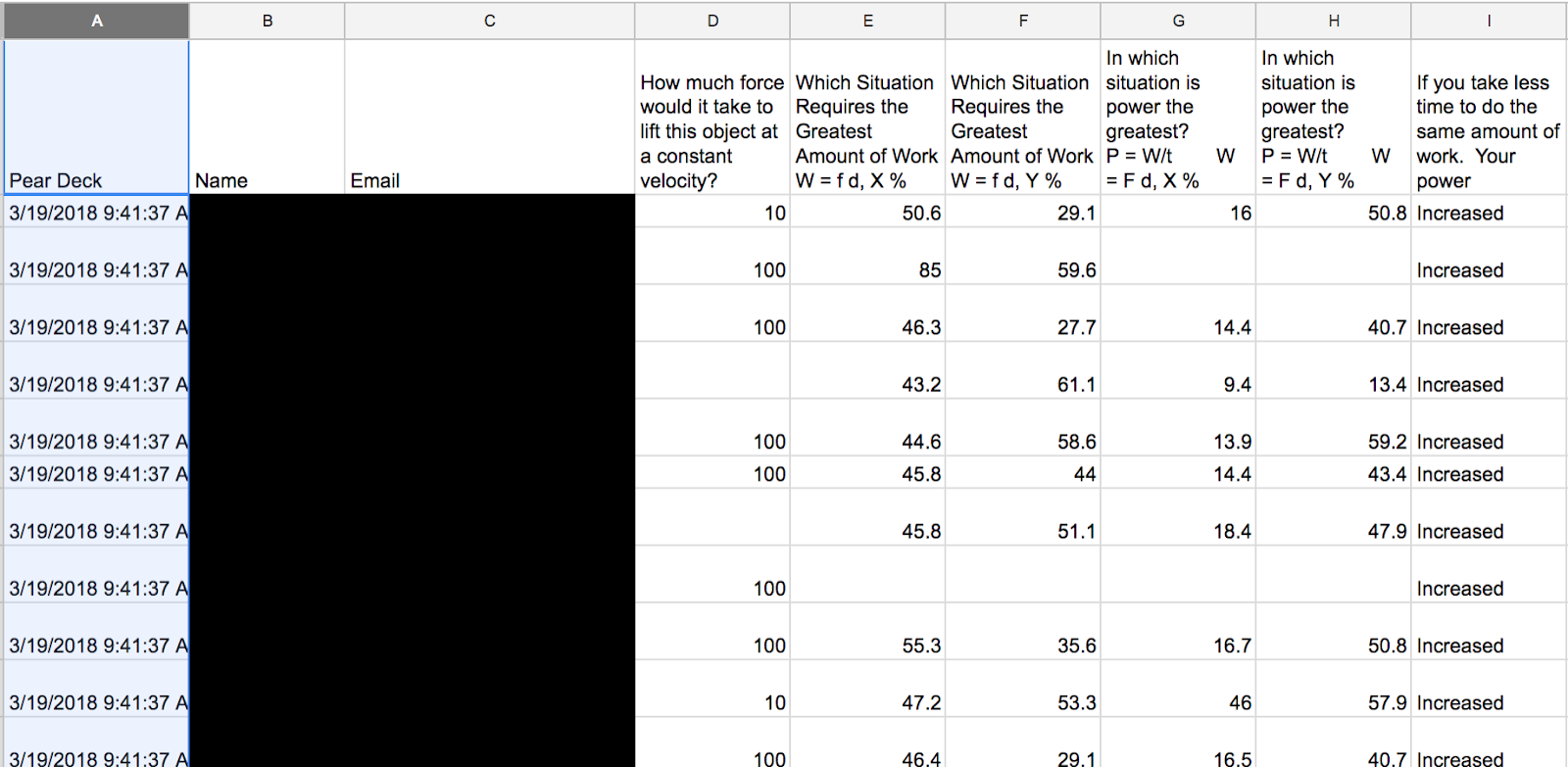
Once you’ve closed a session, you can see how individual students responded to each question by exporting a Google Sheet. This will give you a chance to look more closely and quickly at who was struggling (or not engaged) and look at some of text responses in more depth. (I’ve blacked out names and emails.)

Feedback for Students and for Educators

Pear Deck is a great tool, but it is still a tool that must be put to work. The interactions you structure will help make it a useful tool. Understanding why your are using it and what you are asking learners for is the key to making it powerful. The interactions are a powerful tool to
  • Check understanding during instruction
  • Have students confer with peers
  • Have students summarize learning 
  • Have students make hypothesis or state opinions before instruction
  • Give students a chance to provide feedback on instruction
But in all cases, questions will be more useful when the teacher understands why the question is being asked and knowing what can be done with the results.
I’m a huge advocate for Pear Deck because of the positive feedback I get from my students about it.  I use a bunch of different tech tools and strategies, but the use of Pear Deck is always the one thing students say helps them learn the best in my classroom.
If you have any Pear Deck questions, please reach out to me!!! (I'm a certified Pear Deck coach.)


Please note, I’ve only focused on the free version of Pear Deck. With a premium subscription, which includes the Teacher Dashboard, you can extend the efficiency and precision of the feedback you can provide. Here’s is little more info of how I use it.

Submitted by Mike Mohammad, Physics Teacher at Brookfield Central High School


Tuesday, March 27, 2018

Using Chrome Bookmarks to Organize Your Drive ...... And Everything Else

Many of us are at that overwhelmed stage where we have access to everything in Google Drive...but we have to search for it, remember the name of the document, or even search for links in our Gmail before we can locate it.  We lose precious seconds and minutes because things we access often are several clicks away.

A potential strategy for organizing all your frequently used documents, forms, sheets, websites, and more is your bookmarks bar. 

To learn how in under six minutes, watch this video:

Submitted by Heather Lemke, School Counselor at Brookfield Central High School

Friday, March 23, 2018

Looking for a Good Read?

Spring break is right around the corner and it's time to be thinking about finding something to read.  Whether looking for an ebook or emagazine to read on your portable device, an audiobook to listen to as you catch some rays, or a totally retro hard copy book, your Elmbrook libraries can help you out.

Overdrive eBooks & Audiobooks
Elmbrook's Overdrive collection has been growing steadily over the years and now has over 6000 fiction and nonfiction ebooks and 1500+ audiobooks.  While you can stream and read directly on any internet-connected device, most download the app to a portable device (e.g. iPad, smartphone, Kindle), select a title, and read or listen wherever they are.

Flipster eMagazines (high school and middle school libraries only)
Similar to Overdrive, Flipster allows you to read magazines online or you can download the app to your portable device, connect to your school library, and read entire magazines cover to cover.

School Library Online Catalog
And of course, if you don't want to worry about recharging or screen glare, check out one of the thousands of hard copy books in our school libraries by browsing the online catalog and stopping by your library to check out a book.

You can access all of these resources from your school library home pages.  Happy reading!

Submitted by Dan Paese, Library Media Specialist and Teaching and Learning Coach at Brookfield Central High School.

Friday, March 16, 2018

Collect Formative Data With Quizzizz To Drive Instruction

Many teachers I know incorporate Kahoot into their teaching as a way to review and measure student progress.  Although I see the value of Kahoot, I wanted to find another web 2.0 tool that I could use with my students that keep things fresh and give me another tool to collect data to help drive instruction.  I found a tool called Quizizz.  Quizizz is very similar to Kahoot.  However, it has some other benefits/features:

  1. It is more personalized- students read questions individually and can move on at their own pace. 
  2. The focus is more on the answers instead of speed.
  3. It saves time- there are many premade Quizziz on many topics shared by teachers and it is user friendly if you want to make your own or if you want students to generate one.  It is easy to share with other teachers in your building or cross buildings. You can pull questions from other Quizizz as well.
  4. It can be used in the classroom or assigned to do at home on a phone or Chromebook.  No need for an account, just the code.
  5. It is easy to share with Google Classroom, Remind, Edmodo, or by giving the session code.
  6. Students get instant feedback on their progress. 
  7. Data is generated through an instant report which lets you look at where students are finding success and challenges both individually or as a class.
  8. It has many uses for formative assessment such as warm-ups, exit tickets, and review. It could be used to introduce a topic or as assessment.

How do you get started?

Visit quizizz.com/signup from any device.


Submitted by:  Corrine Beresford, 8th grade Science and Social Studies at PPMS

Friday, March 9, 2018

Resources and Instructional Strategies in Discovery Education

Over the last year, I have facilitated multiple Discovery Education professional development sessions.  Every staff member, in every content area, was able to find helpful resources.

With so many great resources available in our district, here are a few reasons why you should check out the collection of resources in Discovery Education:

  • Videos: safe and school appropriate...no need to worry about ads or inappropriate content; can search by topic or standard with filters for grade levels. 
  • Instructional Strategies: contains over 100 strategies that can be used to enrich your lessons in any content area.  Each one has a short pdf and video to describe the strategy, how to use it along with extension ideas.
  • Media:  includes a collection of images and audio files; also includes the citation to make it easy to add images to presentations and provide source information. 

Login to Discovery Education
Our Discovery Education accounts are connected to our google accounts.  When you get to the login screen for Discovery Education, click on the "Sign in with Google" button and, if necessary, enter your school email address and password. Then, start searching!

To access the Instructional Strategies in Discovery Education: 

  • Click on Professional Learning in the Discovery Education Menu
  • Click on Strategies and Resources or scroll down to the bottom to see more details
  • Click on Spotlight on Strategies to see the following list ("View all" links will show even more strategies for each category):

Categories of the strategies

For more assistance with using this fabulous resource, contact the Technology Coach/Teaching and Learning Specialist at your school.

Submitted by Joanie Rueth, Technology Coach/Teaching and Learning Specialist at Brookfield Central and Brookfield East.

Friday, March 2, 2018

Providing Descriptive Feedback with Digital Tools

"We can learn without grades, we can't learn without descriptive feedback."
-Rick Wormeli

Giving effective, descriptive feedback can be time consuming for teachers but is well worth the effort. For more information about the "why,"  check out the following article: Why Giving Effective Feedback is Trickier Than It Seems

I have always believed that digital tools are worthwhile if they can make you more effective and/or efficient.  Check out some ways that teachers use tools to provide feedback:

GSuite Apps (e.g. Google Docs, Slides)
  • Google Docs Comments: Allows commenting and replies along with assigning tasks.  To make the process faster, some teachers prefer using keyboard shortcuts.
  • Google Read and Write:  While our district purchased the premium version for staff and students (premium is free for all educators), a couple of the tools on this toolbar can be quite helpful when providing feedback:
  • CheckMarkClass: Chrome extension that allows you to create a toolbar to quickly add comments to a google file.  Teachers have the ability to customize the list with comments they would most frequently use. 
Canvas

  • Speedgrader: When students submit assignments (could be a link to a google file, text entry, file etc..), this tool allows the teacher to quickly flip through the student submissions and provide feedback in multiple ways.
  • Rubrics in Speedgrader:  Attach a rubric to an assignment to provide feedback to students.  Tip: common rubrics can be added in Canvas at the department or school level to save time creating a rubric by each individual teacher.
For more ideas on how to use digital tools to provide feedback, reach out to the digital leaders or tech coaches in your building.

Submitted by Joanie Rueth, Teaching and Learning Coach/Technology Coach at Brookfield Central and Brookfield East.


New Features in Gmail to Save You Time and Keep You Organized

Are you overwhelmed with all of the emails that you receive?   Do you have a hard time finding emails on the day that you really n...